
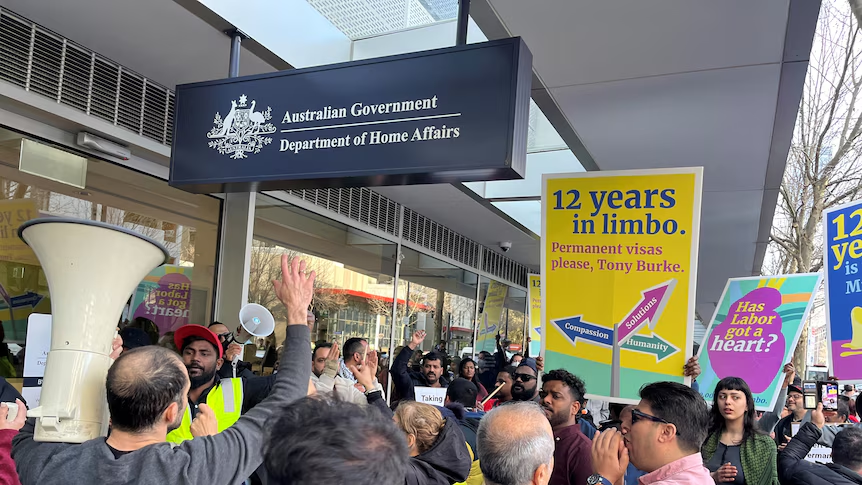
Australia has a long-established humanitarian migration framework designed to protect individuals who cannot return safely to their home countries due to persecution or serious harm. One of the most important pathways within this framework is the Protection Visa (Subclass 866). This visa allows eligible individuals who are already in Australia to remain permanently if they meet Australia’s protection obligations under international and domestic law.
Understanding the Australian Refugee and Protection Visa Subclass 866 is crucial for asylum seekers, advocates, and professionals supporting displaced persons. This guide explains who the visa is for, eligibility requirements, application steps, rights and obligations, processing timelines, and common reasons for refusal—using current Australian immigration rules and authoritative sources.
What Is the Australian Protection Visa Subclass 866?
The Protection Visa (Subclass 866) is a permanent visa granted to people who are already in Australia and are found to be refugees or otherwise in need of protection.
It is administered by the Department of Home Affairs, which oversees Australia’s migration and humanitarian programs. Official policy guidance is available at
https://immi.homeaffairs.gov.au/visas/getting-a-visa/visa-listing/protection-866
This visa reflects Australia’s obligations under the United Nations Refugee Convention, as well as complementary protection laws under Australian legislation.
Who Is the Protection Visa Subclass 866 For?
The Subclass 866 visa is designed for individuals who:
- Are physically present in Australia
- Arrived lawfully or unlawfully (subject to certain restrictions)
- Fear persecution or serious harm if returned to their home country
- Do not already hold a permanent protection visa
It is not available to people outside Australia. Those overseas must apply under different humanitarian or refugee resettlement programs.
Refugee vs Complementary Protection: What’s the Difference?
To qualify for a Protection Visa (Subclass 866), applicants must meet either the refugee criteria or complementary protection criteria.
Refugee Criteria
Under Australian law, you may be considered a refugee if you:
- Have a well-founded fear of persecution
- Are persecuted due to race, religion, nationality, political opinion, or membership of a particular social group
- Are unable or unwilling to seek protection from your home country
These criteria align closely with the United Nations High Commissioner for Refugees definition of a refugee. More information is available at https://www.unhcr.org.
Complementary Protection Criteria
If you do not meet the refugee definition, you may still qualify under complementary protection if returning to your home country would expose you to:
- Arbitrary deprivation of life
- Torture
- Cruel or inhuman treatment or punishment
- Degrading treatment
This protection ensures Australia does not return individuals to situations that violate fundamental human rights.
Key Eligibility Requirements for Subclass 866
To be granted a Protection Visa (Subclass 866), applicants must meet all of the following requirements.
1. You Must Be in Australia
You must be physically present in Australia at the time of application and decision.
2. You Must Engage Australia’s Protection Obligations
You must demonstrate that Australia owes you protection under refugee or complementary protection grounds.
3. You Must Meet Health and Character Requirements
Applicants must undergo:
- Health examinations
- Character checks
In some cases, waivers may apply if refusal would breach Australia’s protection obligations.
4. You Must Not Have Protection Elsewhere
If you already have protection in another country where you can live safely, your application may be refused.
Who Cannot Apply for Subclass 866?
Certain applicants are barred or restricted from applying, including:
- People who arrived in Australia by boat after specified dates
- Individuals subject to “fast-track” or legacy caseload rules
- Applicants with serious criminal convictions (in limited cases)
These restrictions are complex and often require legal advice.
Step-by-Step: How to Apply for Protection Visa Subclass 866
Step 1: Lodge the Application
Applications are submitted to the Department of Home Affairs using the appropriate protection visa forms.
Application details and forms are available at
https://immi.homeaffairs.gov.au/help-support/applying-online-or-on-paper
Step 2: Provide Detailed Written Claims
Applicants must submit a written statement explaining:
- Their personal history
- Reasons for fleeing their home country
- Specific incidents of persecution or harm
- Why state protection is unavailable
Consistency and credibility are critical at this stage.
Step 3: Attend Interviews and Provide Evidence
You may be invited to:
- Attend a protection visa interview
- Provide additional documents
- Clarify inconsistencies
Evidence may include:
- Identity documents
- Country information reports
- Medical or psychological reports
- Witness statements
Step 4: Health and Character Checks
Applicants must complete health examinations and character assessments when requested.
Step 5: Receive a Decision
Processing times vary significantly depending on caseload complexity and individual circumstances. Some applications take several months, while others may take years.
Rights Granted by the Protection Visa Subclass 866
Once granted, the Subclass 866 visa provides permanent residence in Australia.
Visa holders can:
- Live in Australia permanently
- Work and study without restrictions
- Enrol in Medicare
- Access Centrelink (subject to waiting periods)
- Sponsor eligible family members
- Apply for Australian citizenship (when eligible)
Citizenship eligibility details are available at
https://immi.homeaffairs.gov.au/citizenship
Obligations of Protection Visa Holders
Visa holders must:
- Obey Australian laws
- Notify the Department of Home Affairs of changes in circumstances
- Avoid actions that may re-engage protection from their home country (such as voluntary re-availment)
Common Reasons for Protection Visa Refusal
Protection visa applications are often refused due to:
- Inconsistent or non-credible claims
- Insufficient evidence of persecution or harm
- Ability to safely relocate within the home country
- Availability of protection from home country authorities
- Exclusion due to serious crimes
Understanding refusal reasons is essential when considering review options.
Review and Appeal Options
If your application is refused, you may have the right to seek review through:
- The Administrative Appeals Tribunal (AAT), where applicable
- Judicial review in federal courts
Review rights depend on how and when the application was made.
Tribunal information is available at
https://www.aat.gov.au
Importance of Legal and Migration Advice
Protection visa applications are among the most complex in Australian immigration law. Professional assistance can be crucial, particularly where:
- Claims involve trauma or psychological harm
- Identity documents are unavailable
- There are prior visa refusals or cancellations
- Exclusion clauses may apply
Only registered migration agents or qualified lawyers should provide immigration advice in Australia.
Conclusion: A Lifeline for Those in Need of Protection
Understanding the Australian Refugee and Protection Visa Subclass 866 is vital for individuals seeking safety, stability, and a permanent future in Australia. This visa represents Australia’s legal and moral commitment to protecting people who face persecution or serious harm.
While the application process is demanding and evidence-intensive, a successful Subclass 866 application offers permanent residence, access to essential services, and the opportunity to rebuild life in safety.
For the most accurate and up-to-date information, applicants should always rely on official guidance from
https://immi.homeaffairs.gov.au